Houzz Logo Print
daisyblue_gw

Help with LoE

13 years ago

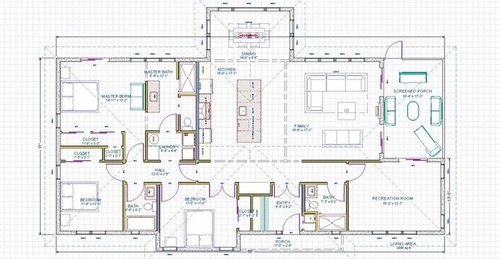
My family and I are building a home in western NC (Zone 4). We are incorporating passive solar design into our slab on grade, one level, just under 2100 sq. ft. home. In researching windows we have narrowed it down to all fiberglass: Marvin Integrity or Inline. I need help in determining the best way to go with the LoE options. The top of the plan below faces south. The Marvin dealer we are working with is recommending LoE 366 on the North, East, and West sides along with LoE 272 on the South side. Does this sound appropriate? I am wondering if we should instead go with LoE 180 for the South windows? Is LoE 189 appropriate to consider as well? We are planning to have 2 ft. overhangs all the way around (hip roof). Thank you for any insight you can offer!!
Comments (10)

  • PRO
    13 years ago

    What is the exterior wall construction and insulation design going to be like?

    i.e.....how energy efficient are you trying to make the home?

    Depending on what you are trying to accomplish, there are some triple pane, high SHGC windows out there that will provide more passive solar while keeping the U-Factor low.

    If you are going double pane, the more widely available 272 and 366 are the correct specifications in my opinion.

    Here is a link that might be useful: Cardinal Glass Performance

  • 13 years ago

    With 24" overhangs, I would be inclined to use the 180 coating on the south facing windows rather than the 272.

    For the rest, I would lean toward 272 facing east and 366 on north and west.

    LoE-180 is a great coating to use in high solar gain applications, and I would always highly recommend it in that application, however if you feel like being a bit of a rebel, you might consider asking about the possibilty of I89 on surface 3 of the windows facing south rather than 180.

    Although not marketed as a surface 3 high solar heat gain coating, when used in that application I89 may be the very best high solar gain LowE coating available world-wide.

    Honestly, I don't know if you can actually get an IG fabricated with I89 on surface 3, but I am very curious to see what would be the reply if someone were to ask.

    By way of comparison (all comparisons 3mm glass, center-of-glass, and 90% argon fill):

    dual pane clear glass - U.455 SHGC .778
    triple pane clear glass - U.289 SHGC .702
    dual pane, LoE 180 surface 3 - U.260 SHGC .685
    dual pane, LoE I89 surface 3 - U291 SHGC .746

    This post was edited by oberon on Thu, Aug 1, 13 at 13:06

  • 13 years ago

    @WindowsonWashington ~ Thanks for your feedback! As of now, we are planning to have 8" walls filled with hempcrete, flanked with lime stucco on the exterior and MgO board on the interior. While we would love to go with triple pane, double pane is more realistic for our budget. To clarify, you think 272 is better than the 180 for the windows on the south side?

    @Oberon ~ I appreciate your thoughts! I will indeed check on the 189 on surface 3 and let you know what I find out. Having 272 on the east windows is something to consider. Are there any concerns with having different LoE coatings on windows in the same room? Is it noticeable?

  • PRO
    13 years ago

    If you are staying with standard glass options, 272 is fine.

    If you have the option of the 180, go with that on the South Facing windows.

    With that type of wall design and insulation levels, I would highly recommend trying to put triple in the budget.

    The resultant U-Factor performance increase will have a larger impact on wall R-Value averages that you suspect.

    Factored into a 30 year construction loan, the triple will more than pay for itself...multiple times over.

    Lets assume that you 8" wall has an R-Value of R-25 with all the framing (if you are running some sort of foam exterior or staggered wall, that number will be much closer to the 30 range).

    If you stick a double pane window in there at a U-Factor of 0.28 or so, the average R-Value of that wall (assuming a 30% wall surface area being windows) is only R-8.9 for the total wall assembly.

    Change that window to a triple pane window with a U-Factor of 0.18, average wall R-Value goes to R-12.2.

    The numbers are even more dramatic if the walls are more efficient. For example, if you figure the walls are R-32, the overall improvement is from R-9.4 to R-13.2

    Food for thought.

  • 13 years ago

    @WindowsonWashington: Thanks again for your very helpful feedback. Would it be reasonable to put triple pane windows on the north, east, and west sides, leaving double panes on the south? Do you have a rough, general idea of the upcharge for triple pane windows in the Integrity line?

  • 13 years ago

    Hi daisyblue,

    Having different LoE coatings on two different windows that are next to each other can be very noticeable, but on windows on different walls it is less so - as long as the coatings have close to the same visible light transmittance.

    Using 366 (66% VT) and 272 (72% VT), for example shouldn't be noticeable in normal conditions, but using I89 (89% VT) and 366 on windows on different walls in the same room is probably going to be pretty noticeable.

  • PRO
    13 years ago

    +1

    Don't mix glazing on a similar elevation. They can be noticeable.

    I think you could put the triple pane on those elevations as long as there isn't an adjacent window with double pane.

    I can't offer any real feedback on prices. They are very specific to dealer and region. The dealer should be able to get you squared away very easily though.

  • 13 years ago

    In my opinion mixing the glass energy options sounds better in theory than it actually is. Think about looking out from a corner room that has multiple windows looking out different directions. Some people will never be able to see a difference others it will drive crazy. Your better off sticking with one type throughout.

  • PRO
    13 years ago

    If the homeowner is building a high efficiency structure, window glazing and resultant U-Factors will have a considerable amount to do with room comfort and efficiency (assuming the other weak spots are closed up and it sounds like they will be).

    Everything is a trade off at the end of the day and while I would prefer the visibility of clear glass, I wouldn't trade Low-e for visibility.

    Also, when it comes to the look inside the home, the fact that different exposures of the home will have different amounts of visible light, shading, etc, the differences are larger imperceptible if you keep them standard to a given elevation.

    Window treatments and other items further mute the potential differences.

  • 13 years ago

    I would agree that if energy efficiency is your primary goal then it could be the way to go.However if the home has scenic views I would find a low e that balances visibility with efficiency and maintain that consistency throughout the home. I like 272 but not sure if that meets the OP's energy needs. Here is a basic comparison.

Sponsored