Houzz Logo Print
webuser_858647138

monochrome gardens

My seed orders are tipping towards an all blue and silver scheme. This won't do at all...and thanks to the resident escholtzias, nasturtiums and poppies, is unlikely to remain an austere restrained landscape. However, I have dabbled with monochrome planting in various beds and borders...and have definitely fallen under the influence of the silver fox brigade, with convolvulous cneorum, onopardum and santolinas and the like, at various times. My eldest still maintains a white garden, and I have borrowed a Hidcote scheme, with red and purples, several times. On the whole, these colour themed plantings seem to require a certain amount of planning and discipline - talents which are in short supply for me. Probably the most enduring colour themes I regularly attempt are lime greens and purples...mostly because these happen to be the colours of my most enthusiastic volunteers (various euphorbias, linaria purpurea, verbena, larkspur, molucella).


What is becoming evident this year is likely to be a moratorium on pink. At least once the blossom has finished. Anyone else have monochrome beds? Carefully maintained borders with a restricted palette? A veto of particular colours?

Comments (29)

  • 3 years ago

    I call the backyard garden here the 'green and white garden' because those are the dominant colors and they feel appropriate for the somewhat shady space. There are pale pinks, pale yellows, a few blues, and some dark red trilliums but white is the dominant flower color and on variegated leaves. In the front there is the 'pretty in pink' driveway border, and other beds where cool colors largely predominate. Yellow is not a very common color in the garden - either in flowers or foliage. That is for two reasons - (1) a lot of weeds here have yellow flowers so yellow flowering plants tend to get ripped out automatically! and (2) the house is yellow so that's a big chunk of yellow in the garden and the yellow might clash with the yellow of any yellow plants....

  • 3 years ago

    I have a yellow garden, with forsythia, rudbekia, and other yellows with some orange accents. The rest of my garden tends yowards pink, purple and white with too much ppink.


    The yellow bed was easy as the forsythia was so badly overgrown when I trimmed it back xnd dug out the volunteers, I had a blank bed and had yellow plants that needsd a home.

  • Related Discussions

    Do you like yellow?

    Q

    Comments (49)
    front doors have to be yellow for me. don't care about fashion - we lost the house we wanted in 1984 [it had a lovely yellow door] and so we bought this one, painted the door yellow, and it's been that way ever since. i hate my yellow walls in the kitchen, though. they've got to go...
    ...See More

    Terrace Upgrade (before and after)

    Q

    Comments (35)
    Always a no to fake grass from me. it would cheapen the effect you have created so much. It always looks tacky. Some more plants would look great. Evergreen agapanthus would give year round green with beautiful spikes of purple flowers in the summer 😊
    ...See More

    Live Chat: How to bring personality into your home, December 3rd 12pm

    Q

    Comments (66)
    They'll never go out of style Tom - NEVER!! Haha! A10) Ohhh I love eclectic style, Maxine, and yes, I mix styles all the time in my own home! I will say, for as easy as it sounds to just throw everything you love into a space, it’s actually one of the hardest looks to do really well – that’s not to discourage you of course because when it all comes together, it’s incredibly satisfying! While it may be tempting to just include everything you like from all different styles together in one space, the resulting feeling will be one of over-stimulation and confusion. So the secret of this seamless integration requires creativity and some self-imposed boundaries. Sticking with a structured colour palette will give the room cohesiveness without making the room flat and uninteresting. Start with a neutral base for your larger pieces, your paint colours and/or your flooring as a means of grounding the space. Pay attention to how pieces relate to one another and how they relate to the room as a whole. One oversized piece is absolutely fine but 3 or 4 will make the room look cluttered and uncomfortable. Despite using mid-century hoop chairs alongside a more traditional chesterfield in my own living room, the backs of the chairs are of similar height to the low-lying sofa back. There is continuity of the eyeline and nothing jars too dramatically. You also want to ensure that when borrowing from different eras, you mix and match throughout the space – having a mid-century console table with art of the same era hanging above it and then a Victorian style fireplace with an ornate mirror in a different part of the room is going to look ‘off’. Take that artwork and hang it above the fireplace instead and perhaps use the more ornate mirror above the console table instead! Hope that helps!
    ...See More

    what would you add to this room?

    Q

    Comments (31)
    I think your layout is perfect to the size of your space. Don't move any furniture and leave as it was on Pic #1 at the very start. Back to question about colour, I have several examples for you how to create combination of cushions. Amount is up to your taste. But I will recommend minimum 5 or 7 but you can go for more 9 or 11. It depends on how many cushions you like when you seat on sofa. You can get several shades and even with similar pattern Go for several colours but of the same fabric (By the way, this photo, shows you great example of green and flowers arrangement around the place. Get as an idea)) The easiest option here. Simply go to fabric store, pic velvet or other plain fabric you like, choose several colour tone or close shades of the same fabric to match. Similar fabric, easy to match. Or go for brighter colour to complement your main colours scheme.
    ...See More
  • 3 years ago

    No monochromes in my gardens although I do enjoy a well done white or "moon garden". I just don't have the room to be that restrictive. But I do tend to plan out color combinations. I have an area that is primarily a pale yellow/gold and purple (both foliage and flowers); another that focuses almost exclusively on red flowers (both green and gold foliage) and my tiny, mostly sun area that is blue with orange accents. White is an accent color I use throughout my gardens and tend to draw them all together.

    You will just not find any pink in my garden! It is not a color I favor at all.......in fact, I am not wild about pastels in any form and prefer stronger, more intense colors. And I focus as much - if not more - on foliage color than I do on just the flowers. They are far too transitory to be the color mainstay of any garden, IMO.

  • 3 years ago

    I rely on foliage in my shadier areas while in the sunny part of the garden, I have no foliage plants apart from grasses. I grew a lot of foliage plants for customers gardens(to provide the bones and structure) whereas I have always been OK with a transitory mish-mash of flowers,. However, now I am trying to build a coherent garden, foliage is playing a much bigger role. I have several plants with negligible flowers and eye-catching foliage (such as my new buddleja) and because it is a dry garden, glaucous, hairy leaved plants are in the ascendant. So teucrium, dianella, celmisia, pasithea, rue, limonium and the likes.


    I always struggle with white in my sunny gardens, keeping it for the shadier parts of the garden (I love the serene colours of your gardens, Woody)...but yep, like GG, I am not really a pastel sort of person. I do like pink though (roses and blossom) and can imagine a soft landscape of blues, lilacs, greys and pinks...but not with oranges, plums, scarlet and bronzes I especially love. I think yellows might be a bit dodgy too.


    So yep, I am putting a colour restriction of no pinks or yellows (unless violent pink or the palest yellow possibly). How disciplined I am remains to be seen so I won't be betting the farm on maintaining this (ahem) scheme.


    Very bold, Sigrid - must be a wonderful wake-up after winter.

  • 3 years ago

    Actually, although my yellow garden is kind of overgrown --- too much tall stuff competing --- it turns out to be visible from my kitchen table, something that I didn't notice so much when it was just overgrown forsythia. I did it more because I had a bunch of yellow plants I wasn't that fond of and I'd cleared out that patch of forsythia.


    I don't know how many previous owners before was the gardener. By the time I got there, the forsythia had drooped over to the ground, rooted, grown to a sturdy plant, rinse and repeat a few times. I had a thick hedge encroaching on a thin strip of grass. The forsythia in the back got no light, sent out extremely long shoots in search of it, which just added to the mess. When I started hacking, I realizes that the forsythia would look a lot better if it was just the original row of plants, which left a bare patch in front that I hadn't planned on. I just transplanted all the yellow plants that I didn't really like from elsewhere.


    But, once it was pretty much cohesive, I really love it. I have yellow blooms pretty much from spring to late fall (I let a few goldenrod in) all visible from my kitchen table. It makes me happy, rather than being some meh plants I'd feel guilty for ditching, which is what they were before.

  • 3 years ago

    I prefer the colors blue, purple, yellow and white. My gardens lean heavily in that direction because plants in those colors are much more likely to follow me home. I have no discipline.

    I would never win a battle with my yellow weed flowers, so I work with them. The only real pink season is with the rhododendron in May. Fourth of July there is an explosion of reds and orange with thousands of daylilies and the cacophony of summer bloom swimming in drifts of red Beebalm. That fades back to blue, purple, yellow and white for the end of summer. I have plenty of Joe Pye. I find the color more of a dirty mauve than pink.

    Color isn't just about flowers. It can be just as much about foliage, bark and berries. And it can be just as desired in the dead of winter. Blue, yellow and amber. The white will be along any day now.


  • 3 years ago

    'It can be just about foliage bark and berries'. And, I must add, topography. As one of those with gardens which are relentlessly flat, (a totally flat area, within the flattest part of the country), I can only sigh in envy at the possibility of vistas, microclimates, hidden valleys and inclines.

    I would not grow a rose which did not produce a fulsome crop of rose-heps...and, of course, my beloved sorbus ( my eldest is named Rowan - a good name for a gardener).

  • 3 years ago

    Sorbus would be a fine name for a gardener too.

  • 3 years ago
    last modified: 3 years ago

    i have one long shady area that i've turned into a white/green garden (is that a moon garden?). Things are still young, so it's developing, but this year at least I had some good flowering on my young goatsbeard and astilbes. Some astilbes ended up being pale pink, so I had to relocate them this fall. I'm hoping next year it is mature enough to look like what my mind's eye sees. It includes heaps of japanese pachysandra, many various hostas, silver-leafed brunneras like Jack Frost, lungwort, goatsbeard, astilbe, lambs ear. The lamium is barely surviving so I'm not going to include that in the future. I have a great deal to learn about how to make this look good, and how to limit the generous spread ;-) of the pachysandra. Before I settled on green/white I put in some Sun King Aralia. They are doing OK, but I suppose I should consider if they should be moved. Years of drought are tough for them under the canopy because they really don't get enough water.

  • 3 years ago

    I admire Gottagarden's red bed and you can see some lime green and bronze in there:


    https://www.gardenweb.com/discussions/1905783/my-red-bed-second-year-9-photos#n=97


    I don't see posts from Gottagarden anymore. She has some of the most amazing designs with irises as well.

  • 3 years ago

    I don't have monochromatic gardens, but like gardengal I do have areas which have (almost) only certain colors and color combinations. I DO like pink lol - I love it actually, and I love pinks and purples together.


    I'm actually working now on making the long border along my property line more cohesive and ... gradient? Flowing? At one end I have a small red/yellow/orange bed, which was an experiment started a few years back when I noticed more orange creeping into my garden. I'm not a big fan of red, but I am trying to incorporate a bit of it, so I started this garden. The oranges are really orange and the yellows are very bright.


    At the other end is the area with all my various pinks and purples, some pale yellows, etc. So I am trying to bridge/connect the two ends with something in between - corals, apricots, shades of purples and yellows, differing shades of what colors I already have, etc. The end goal is to have everything flow in one fluid color palette from one end to the other, including foliage color. (I hope that is clear - can't seem to explain myself today!) Will I accomplish that? LOL I'm not sure but I'm having fun trying!


    Not a huge fan of white either, but I do like to have white in the shade gardens. This past year was the first year in about a decade that I attempted edging my shade garden with white impatiens (Beacon White, supposedly mildew-resistant). I love the way the white pops in the shadier spots.


    :)

    Dee

  • 3 years ago

    deanna - what white do you have in higher layers? I particularly like the white-flowering redbud trees we have and the variegated Wolf Eyes dogwood (that is young and hasn’t bloomed yet - but I don’t care if it ever does since the foliage is so showy!) The first Wolf Eyes we tried died after a few years since we planted it in a quite dry spot. We planted the new one near a pine tree stump which acts as a ’nurse log’ to hold and provide moisture and provide nutients. So far the dogwood seems to be thriving there.


    diggerdee - I know what you are trying to do as we tried that here in a shorter space than what you describe. I would love to see pictures of yours…! Here is something you might try in the middle. The Oso Easy Peachy Cream rose is a good color for that section although I have found it a bit disappointing as it is not as vigorous as the other Oso Easy rose in that bed. Mind you, it might help if I remember to fertilize it sometime! :-)

  • 3 years ago

    Woodyoak, thanks for your response. This are already had the pachysandra (which was a mess) and a message overgrowth. I’ve trimmed away saplings and suckers, but I haven’t planted any new floiwering trees. There are very mature rhodies already, like 10 feet tall, and they have magenta blooms which start long before any white flowers. You’ve got me thinking, I wonder where I could put a flowering tree.


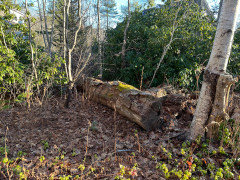
    There is a HUGE trunk on the ground near this area, probably 1.5-2’ diameter. I often think about it as a nurselog after some of your earlier posts coincided with other garden writers on the same topic.

  • 3 years ago

    Here’s my nurselog. Do you think it will work? I could probably find a tree for here.


  • 3 years ago

    Deanna - what was the nurse-log when it was alive? I’ve found that softwood trees work best because they breakdown easier. Whatever that is looks like it is breaking down now so I’d be inclined to consider it - but would also be thinking about its future re things like would it move (either on its own or be moved by people for various reasons)….? Could you (or a helpful someone) cut a piece off it and move it to a place where you’d want to plant a tree?


    I’d love to have some rhodies but my neutral-to-alkaline soil doesn’t suit them! I’ve tried to grow them… :-(

  • 3 years ago

    Thanks for the link to Gottagarden's post, I miss seeing the updates from there!

    There will be no monochromatic gardens here, I just don't have the discipline for it. As it is I try not to overdo certain plants which are irresistibly reliable, and have a couple beds which "lean" towards gray/orange/blue or reds. For me the no-no color is that 'crownvetch pink' which seems to have a touch of blue in the pink and I just don't like it.

  • 3 years ago

    I don't think I'm capable of a monochrome garden. I do have zones in my garden which have more warm colors grouped. But I like a mixture of colors for the most part.


    One time I made a quilt for the first time and couldn't resist all the different colors and patterns of fabric. I don't think the quilt came out beautiful. Quilts with a limited color scheme seem more harmonious to me.

  • 3 years ago

    I do a lot of stranded knitting (Latvian mittens, Fair Isle stuff) and it always surprises me how unpromising colours will go quite well if used in repetition and with confidence. Apart from yellow and pink which is my worst colour combo ever. Also, tones are often more important than colours - if the tones are on the same scale, all colours will play well together.

  • 3 years ago

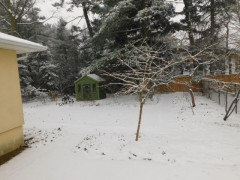
    It's pretty monochrome out there this morning!:


  • 3 years ago
    last modified: 3 years ago

    Beautiful work, Woody.

    Have been a Kaffe Fasset knitter too...but all that intarsia! (I am a strictly stranded knitter)

    It was definitely through textiles where I developed any colour sense.

    Gardening and knitting had another crossover for me, after growing dye plants - although I generally use easy-peasy acid dyes for my yarn, tbh, after many wasted years with madder!

    Will try to find something to photograph although I am so rubbish at that.

    Your fella looks well proud!

  • 3 years ago
    last modified: 3 years ago

    Yeah, DH’s sweater was inspired by a Kaffee Fasset one but I found the Fasset pattern bloocks to be boring colors and too big blocks, so I reworked it to suit my vision - the same sort of thing one does when taking someone else’s garden design and customizing it to suit your taste and space…. (DH loves that sweater and 25+ years later still wears it for special occasions! It looks especially good with fall colors… But I don’t like the one I made for me and rarely wear that one now!)

    P.S. I never dyed my own wools but bought Rowan yarn from the UK. I always thought it would be fun to learn to spin your own yarn - have you ever done that?

  • 3 years ago

    I have every color of bloom. If it has nectar or interesting foliage, it's welcome. I used to garden for the appearance of the garden, but now I just want to watch hummers, butterflies, bees, come by and do their thing.

  • 3 years ago

    Woodyoak, it is definitely a hardwood, but I don’t know. If it was a softwood it would be poplar, but there’s no way a poplar would last that long without decomposing. I was hoping that, as old as it is, it would be ameniable to decomposing.

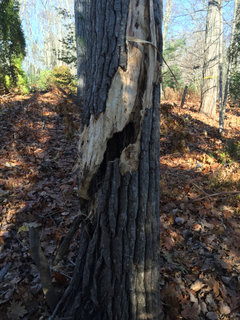
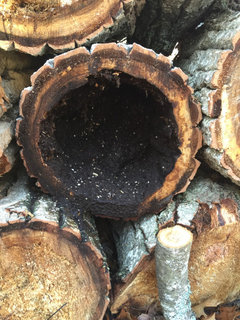
    Below is a picture of a poplar whose insides thoroughly rotted out. Beutiful compost inside that tree!

    Tiffany and katob, I have areas with lots of color, but they are newer beds. I’ve really got more garden than I should, for sure. This area already had already been established a long time ago and unmanaged. once I cut all the scrub and saplings out, I could work with the existing sea of pachysandra, weedy grass, and weedy weeds. There was already so much green that is was actually kind of the easiest choice.


  • 3 years ago

    deanna - I was thinking of aconifer of some sort as a softwood.. As long as whatever hardwood it doesn’t give off chemicals that deter other things from growing - or sends up a lot of suckers from the roots, it should be OK I think. Is it decomposing now? (It looks like it is in the picture… is the wood soft and crumbly now?) Do you have nice broad paths through the woods? If so, I’d fill remaining relatively open spaces with understory trees, shrubs, and perennials that have one or more of nice flowers, good fall color, and/or good fruit. I grew up in southern NB on my maternal grandfather’s farm-going-back-to-bush (he was 80 when I was born) so I suspect my mental image of your space is affected by that experience as the overall landscape is not too different in NB vs. Maine….

  • 3 years ago
    last modified: 3 years ago

    Mostly purple here, with the silvery Lamb's ear and other different shades of green and variegated foliage. Also ornamental grasses. I like the "feeling" a garden gives me and a monochromatic scheme is one I find calming. A lot of different colors feels busy and gives me a restless feeling, so I avoid that. Generally no pink or red and maybe a splash of yellow here and there. I enjoy other people's gardens that are a riot of color, but for myself, where I spend the most time, I like a very calm color scheme.

  • 3 years ago

    Woodyoak, it is the side of our driveway so paths are more maintenance oriented. I've got a lot of feet to play with there, so your suggestions are good. I am SO SO SO bad at designing trees and shrubs in my garden. It's honestly a huge block in my deisgn skills. because of that, I don't naturally go there, but you've got me thinking about what I can do there.

  • 3 years ago

    deanna - the first thing I'd do is to walk around your woods - and any local, open-to-the-public woods - looking to see what grows there naturally. I remember ground-level things like bunchberries, wintergreen, red trilliums, starflowers, various club mosses (which, as kids, we'd dig under snow to find to make Christmas wreaths! ) then at the next level there were rhodora, chokecherries and serviceberries, and then above that larch/hackmatack/tamarack and lots of spruce, fir, cedars.... There was lots of other things too...! See what already grows in your woods or locally that would be attractive to add or expand. Keep the paths clear and make them an important part of the structure. Wild blueberries, raspberries and blackberries grew well at the edges of the wooded space so they got enough light. I find 'woodland gardening' very appealing! Paths and clearing (e.g. where the house is) are important to the overall look and feel of the space. (The rectangular lawn in the backyard garden here is inspired by the shape of Grandpa's grazed pastures surrounded by wooded areas - most people see it as a 'formal' look but it is a reflection of the 'wild' space I grew up with.) With the rise of problems with ticks, I think it is important to keep paths wider than you might otherwise do just to reduce the risk of being in contact with stems/branches etc. that might be contaminated with ticks. They were not something that we worried about back then (even with a large deer population). Be careful but 'go for it'...!

  • 3 years ago

    I admire people that can plan ahead with color, foliage, height and spacing. I'm getting better, but tend towards mish mash and then the transplanting begins.


    I am also impressed with your usage of plant names. I learn quite a bit reading these forums.

Sponsored