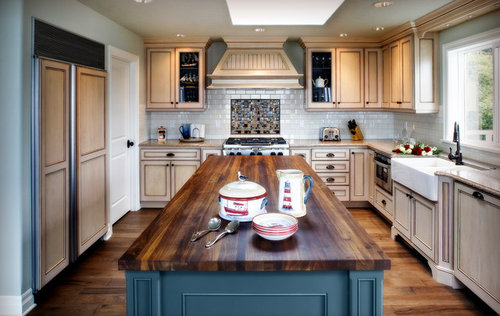
The butcher block is walnut. Our wood worker took care of it for us. I don't know the process, number of coats or the actual brand name of the stain he used to give us our finished look.
This butcher block top was laminated using a dark walnut material. There is no stain on this top. It was originally glued together from reclaimed wood, planed, then several sandings from rough to fine. We then used several coats (6-8) of Howard's Butcher Block and Cutting Board Oil. Any oil on wood acts like a stain and give that rich color. Although this is a safe oil and this top can be cut on I think the piece is too beautiful and the customer may never cut on it. It's an on going process though. The customer has to treat this every 4-6 months to keep it's beauty and just a little goes a long way. It's more like dusting and sealing now. Fingerprints and stains come right out with a little fine steel wool and then rub them out with more oil. http://www.howardproducts.com/prod-butcher-block-cutting.php
I love my walnut butcher block and, you're right, that I never cut on it. I do tend to oil it more frequently if I want it to look as lustrous as this...more like every 2-4 months, but oh so worth it!







Angela Todd Studios | Portland, OR
Oglesby Construction Company, Inc.
Related Discussions
Rescue smoothie stained wall
Q
POLL: Hardwood flooring - paint or stain?
Q
Staining outdoor studio black?
Q
Any stain ideas for these red oak floors that need be sanded/stained?
Q
Sandy Bacharach
gobucks71
Oglesby Construction Company, Inc.