

Pre-Construction Consultation Fee
Is it normal for a contractor to ask for a consultation fee before they will give you a bid? Our Contactor wants $2,500 to put a bid together, help me sellect finishes, and establish a timeline. We are doing a kitchen remodel and a small addition.
Comments (90)
 8 years ago
@Mica Moore Yeah, I'd find someone else then, that's all kinds of red flags. Part of every project that a contractor tackles includes their profit and overhead baked into the equation, Part of that overhead includes the legwork of getting new contracts and that most certainly includes everything involved in a preliminary estimate.
On your side though, if you haven't already started the process, start recording the elements that you want incorporated into your kitchen. @beckysharp makes some good points from the GCs perspective, the more info they have the more accurate their numbers will be.
You can actually do this all in Houzz too (top right under "Your Houzz" --> "Your Ideabooks") Create one for each element of your kitchen and populate it with photos of designs you like, for example:
flooring
countertops
cabinetry
color schemes
appliances
lighting
tile work
Having these will help a lot when meeting with potential GCs because it gives them much better information for their estimates.
 8 years agolast modified: 8 years ago
If the architect created specification documents, that can happen, and no one should need a fee to develop their own specification documents. But if all the architect did was create a space plan, and no specification documents exist, someone has to narrow down the fit and finishes that need to be used to satisfy the honeowner’s expectations. That is design work that someone has to be paid to do.
If that design work is portable then we agree. However, if the contractor is doing the design work for his benefit only, and that work isn't allowed to be used by the homeowner as the basis for other bids, then that is part of his bidding process and nothing more.
Mica Moore thanked bry911Related Discussions
Converting a communal rooftop into a rooftop garden?
Q
Comments (9)No experience but it might be an idea to talk to an estate agent to see how much value having a communal garden would add to the property value/rental income. It could well give the landlords a reason to invest. Even if it doesn't add significant value in cash terms it could however mean flats never remain unoccupied. There may also be some budget within the management company's pot? Hopefully the offices would be willing to chip in as it's of benefit to their employees. The only potential issue I foresee is with the bars, how do you stop drinkers accessing the terrace? Do all owners/tenants have access rights to the terrace? Have you spoken to other residents about this? I would probably suggest holding a residents meeting. Outline various proposals for developing it. If you have support from other residents then elect a committee etc to drive it forward ie seek quotes for each option, time to develop, check if any planning permission is required, outline the incentives etc etc. Once you have all this information regroup with the residents, take a vote on the favourite and then present it to the the management company. I'd also have a look to see if there are any grants available to subsidise...See MoreNeed advice on kitchen extension and loft conversion
Q
Comments (16)I would slightly disagree with comments above. I'm coming to the end of a renovation project that has taken 3 years from concept to reality. We initially contacted a local building contractor who put us in contact with his recommended architect. We all sat down together and worked out a design/plan and budget for our renovations. If you don't consult a contractor at the beginning you could find the beautiful architects drawings you have - and have planning permission for, are completely unaffordable! I agree at the design stage a contractor will not be able to give you detailed costs - but they can at least advise what design elements would come within your budget. Also we found good reputable builders can be booked up anything up to a year in advance - so yes if you want to start next spring you need to get started with plans/budgets etc. As for moving out - that would depend on the existing and new layout of your house - and if the building work can be done in stages minimising disruption to your living accommodation. With our project we were left with no choice really but to move out. For us it's made for a much less stressful process and probably a considerably quicker build time. Most of all good luck with your project. I've enjoyed our ours so try to enjoy the process!...See MoreExtension ??
Q
Comments (29)This comment is a bit late, but we bought a house last year that was extended in 1992 over not one, but two, manhole covers (kitchen and cloakroom). Both had been tiled over but with sealed hatches that could be lifted in case of emergency. In 25 years this was never necessary but the idea of leaving them in tact was a little unpleasant. It's a public sewer that includes several neighbouring houses. We just undertook an extensive house refurb and moved the manhole access points outdoors and permanently sealed the internal ones. It wasn't as complicated as we originally thought. What you want to do as a starting point is get a drain surveyor to come and inspect the routes and flow of waste. We used Power Rod (we are based in Hertfordshire) and they came with their camera on a hose reel and mapped out our plumbing routes all the way to the mains in every direction. Then your builder will be able to take it from there, or you can hire a specialist grounds company to sort it out. If it's any help, in your head you may have this idea that raw sewage is just gushing under your floorboards but in reality, when I looked down the hatches, it's really just a matter of a few pipes several meters down. It was surprisingly more sanitary than I expected and I found that reassuring....See MoreWhich professional to consult first?
Q
Comments (15)Hi Sue, Congradulations on your new home. I believe that you can make a good place if you involve specialists. When we start a project for an existing house we recommend to do a construction audit of the building. That will help you to know what changes you can do with your house. For example, you decide to update facades and you will be sure that you can use any materials. The same situation with a new stairs, windows etc. As for the project. We usually offer these steps: 1. Zoning and planning. On this stage you will see how all the rooms will be located; 2. Concept idea for a new interior design and facades (if applicable). We prepare 3D photorealistic visualizations; 3. Preparetion of project documentation and choosing of the materials in accordance with the concept; 4. Preparetion of the detailed construction documentation that will help your builders to make real the idea of your new home. You can see some of our projects on this page (we are a Russian team): https://www.houzz.co.uk/pro/olarchitects-project/olarchitects Please, contact me if you have any questions....See More- 8 years ago
Maybe it was because we had a year of planning prior to our remodel, but we knew we wanted mid range semi custom cabinets, stained, and knew what we wanted for flooring, etc. All the GC’s we quoted did give us allowances for door, window, counters and faucets, but we had looked enough to know what was reasonable and what wasn’t. All were pretty reasonable. Our architects plan included cabinets down to specifications such as “4DB24” for the whole kitchen. Yes, we went over a couple allowances but our granite came in under, so in the end it pretty much evened out.
I can definitely see if every contractor was going to go through all the details so there would be no estimates it would be a more involved process, heck, they would have to have you actually choose a counter to give you a quote, which is nuts! But I would also be concerned at that point you aren’t getting apples to apples bids. At least with allowances I can see that one guy is giving me $3k for counters and someone else is giving $8k. It allows me to ask questions and get a better understanding of where we will likely fall and what is reasonable. I can definitely see that allowances could allow someone to underbid, but that is also part of the benefit of getting multiple bids and then educating yourself on the differences.
- 8 years agolast modified: 8 years ago
@bry911 "If that design work is portable then we agree. However, if the
contractor is doing the design work for his benefit only, and that work
isn't allowed to be used by the homeowner as the basis for other bids,
then that is part of his bidding process and nothing more."EXACTLY, and sadly that's what were seeing from most of the 'Pros' chiming in on this and other threads. For our project we had our own designer that handled all design details. But had we not, most of the contracts we had looked at had clauses in them where THEY retained sole ownership of all designs and drawings etc which is absolute BS if a fee is being charged. If I'm paying my hard earned money to you as a 'fee' for design then I damn sure better get something I actually own for the price.
- 8 years agoWe used a design/build contractor for our kitchen, and we worked with their In-house KD. We had to pay $2,800 for her design and specs, but only if we didn’t end up contracting with them. We did end up contracting with them, and we were very pleased with the results.
- 8 years agoI would add that the cabinets that our contractor sells were outrageously expensive (for us), so we cut the cabinets out of the contract and contracted separately with a local cabinetmaker for custom cabinetry which was (much to our surprise) much less expensive and of higher quality. We basically cut out the middle man.
- 8 years ago
@bittley01 we did the exact same thing because our GC was lying to us about the entire process and tacking on an extra 20-25% on top of the cabinetry price. It's really hard to find an honest GC, I get that that's part of the game to some degree, but sleazy used car salesman ain't got nothing on most of them!
 PRO8 years ago
The ownership clause in many professional contracts is meant to protect professionals from others SELLING and PROFITING from their plans. I have such a clause in my contract. It doesn't mean my plans cannot be used by the homeowner to complete their project with another contractor. It means my designs cannot be sold by the client to a third party. It's no different than any other standard copyright clause.
 PRO8 years ago
The subject of this thread--estimates and quotes (bidding results)--is a common subject, with many past thread on the subject.
Many consumers have one perspective on the two processes, i.e., estimates and quotes resulting from a bidding process involving sub contractors. The two processes are miles apart and completely different from one another.
Many consumers don't understand the differences between estimates and quotes. Many more consumers don't have any idea how general contractors come up with estimates and quotes.
The result in virtually all of these threads is consumers saying "this is our opinion of what should happen".
The pros here say this is what actually happens.
But the two almost never ever meet in some sort of resolution.
- 8 years agolast modified: 8 years ago
Although, I have said this many times before, I feel it needs repeating for clarity.
Many of the common legal practices in the construction industry have little in common with the legal duties and requirements of the industry. This isn't a jab at anyone, so much as a statement that what many people think are the practices and obligations of the construction field are often not correct.
----------
Estimate
An estimate is a contractor's best professional assessment of costs. It must include all reasonably known or estimable costs. An estimate must be comprehensive and include all aspects of the job. It doesn't have to be exact, but there is a legal requirement in all U.S. states that it be "professionally reasonable". Courts have established that 10% is always professionally reasonable and 20% is almost always acceptable.
This professionally reasonable requirement can't be generally disclaimed, however, it can be specifically disclaimed if the contractor knows of a specific limitation to estimating. Additionally, things that are not reasonably foreseeable are acceptable exceptions to estimates, as they meet the requirement of professionally reasonable. Estimates can't be off by an order of magnitude.
Obviously, estimates really need to be in writing for them to be enforceable.
------------------
Bid
A bid is one half of a legally binding contract, it is essentially an offer to sell you something and once accepted it becomes a fully executed and legally binding contract. One of the elements of a contract is a meeting of the minds, which is what the formal contract actually does, it sets the terms and conditions of the bid. Technically speaking, a contract can't be for amount different than the bid unless that bid contained some type of expiration that passed before acceptance.
----------------
Allowance
Allowances are estimates inside of a contract or bid. They also must meet the above criteria of best professional assessment of costs. If you have a $10k allowance and there is no possible way the specified construction could be completed near that amount, then you will most likely prevail were you to take it to court. Technically allowances must include everything you specified at the contract point, and be a reasonable estimate for completion. This gets into some gray areas because his estimate doesn't necessarily have to include your desired level of finishes. But were you to specify specific high end brands, the allowance would have to be sufficient to get those brands.
--------------------
The Sad Truth
Realistically, contractors get away with a lot because people just don't sue. Most people simply aren't interested in continuing a bad saga in court and so the worst offenders continue to offend.
You constantly see the words estimate and bid used interchangeably and you see estimates and allowances that are ridiculously low, because they get away with it.
Hope this helps, Good luck.
ETA: I oversimplified in my explanation of a bid, they can be, and often are, disclaimed by adding a line that requires to signing of a contract for the bid to be enforceable.
Mica Moore thanked bry911  PRO8 years ago
"The fee is ridiculous if you ask me. Some people are on here think it's reasonable is because they are in the design/construction business."
Mike:Your response is the logical fallacy of relevance, ad hominem circumstantial. You must address your interlocutor's arguments, not their circumstances.
I do not have to have children of my own to know if your's are brats.- 8 years agolast modified: 8 years ago
Something is amiss here.
Ideally, all labor should be in the Bid and Allowance amounts should only be for materials that have not yet been selected, therefore, if the final Allowance item selection costs more, the Owner cannot make a claim against the Contractor but the contract should allow the Owner to ask for prices from other subs or suppliers. Where labor cannot be bid, Unit Costs should be required.
In the 30 years that I was an Architect's project manager, I listed the Allowance amounts in the instructions to bidders. It would serve no purpose for each bidder to guess at the cost of what the Owner might later select. The goal was to make it possible to compare the Bids.
A Bid is not one half of a contract. Once the final Contract Sum is agreed upon there are many other terms that must also be agreed upon to make a contact like: the date, names of the parties, list of contract documents, date of commencement and completion, payment schedule, insurance, responsibilities of the parties, changes in the work, time, protection of persons and property, correction of the work, termination of the contract, etc.
I have never seen an "estimate" in a construction contract that was "enforceable". In a Cost of the Work Plus a Fee contract a Contractor would prepare an itemized Budget which is similar to an estimate but it would not limit the Contractor's compensation unless there was also a Guaranteed Maximum Price. That's what would be enforceable.
- 8 years agolast modified: 8 years ago
I grant you when a Contractor is bidding on a kitchen remodel, normal construction industry contract terms can be misused. For a negotiated contract (i.e. no other bidders) things can get distorted. If a Fixed Price contract contains Allowances for things that are in the design documents, the owner might think they are fixed or a maximum price. If the contract is Cost of the Work, the contractor might provide an estimate which the owner might think is a maximum price. I suspect these contracts would be difficult to enforce.
Mica Moore
Original Author8 years agoI have gotten other bits on the project, but it was early on in the process. It was before the architects drawings were done. I needed to get to figure out what we could afford, and where to put the addition. I will certainly get bids from the other GCs once the drawings have been completed. None of the others charge for bids. Thanks again for all the feedback.
- 8 years ago
I don't claim expertise on remodeling or construction but I pretty much spent my working life negotiating, drafting and interpreting contracts.
If someone thinks a bid - even with specific line items is enough to form a contract, they are theoretically potentially going down a risky path because it is leaving out a lot of necessary things on which the party should be agreeing on.
I think what the pros are saying is that this is pretty much a marketplace in which the trades people (or at least the good ones) can be as picky as they want. Back in 2008 it was reversed and homeowners had the upper hand.
I live in Los Angeles and literally I can't go down a street without navigating dumpsters and trucks that are obviously owned by the tradespeople and workers on multiple sites. My own experience was that I couldn't get three bids and I felt lucky to get a reputable GC who wanted to take the job.
My contract is a hybrid reflecting the different ways I am funding the total project.
I am supplying everything that is discretionary in terms of taste and cost - i.e. all finishes, fixtures, tiles, appliances, lights etc.
The GC had firm line items for items which he could calculate precisely what the cost of his materials and labor would be - i.e. supplies and labors for the under layers of flooring (I supply the wood); building the shower (I supply the tiles and other materials).
Cabinets and all millwork is being built and installed by a third party from whom I got a firm bid based on precise specifications submitted by my designer
Plumbing and electrical are allowances but these allowances could theoretically be lower and if higher would have to be justified as to why they weren't called out in the original bid. So far as stated, the only thing not covered by the allowance is the need for a new electrical panel because until the licensed electrician went in and actually saw what kind of electrical capacity and wiring I had, he couldn't determine whether it was up to Code - i.e. current Code requires every appliance on its own breaker.
Oddly for some items like electrical and plumbing and HVAC work, I am paying directly to the vendors which is fine with me as I have more control over payment schedules following completion of certain milestones.
Obviously I am responsible for any change orders but so far these have been discrete items which I decided to do in a "makes sense" type of way - i.e. replacing hideous metal interior doors with nice wood doors.
After going through the line items with some adjustments to language, I just incorporated the "bid" by reference into a contract which contained necessary legal provisions regarding warranties, insurance, workman's comp, mechanic's liens; payment schedules; completion dates (ha ha) and other clauses which would be necessary to protect me in the event things really went south. I could certainly have made the guy run the other way by negotiating as if I were doing a deal with a Fortune 500 company but I limited myself to the stuff that was critical to protect myself - i.e. at no point would I have been out of pocket if he had completely flaked out and of course, having seen his work for other projects and knowing he had completed other projects in a satisfactory manner, I really wasn't worried about that.
- 8 years ago
In Massachusetts, Home Improvement Contractors must be registered and must include certain terms in a written contract.
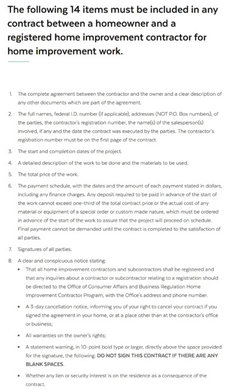 Here are the terms in a sample contract:
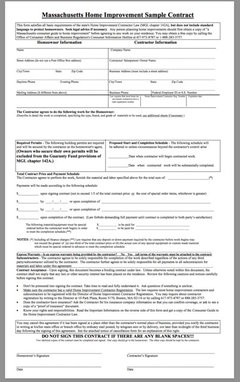
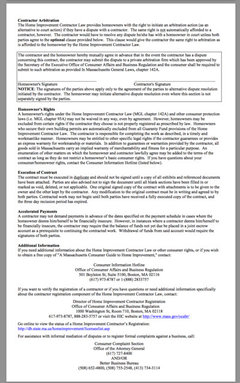
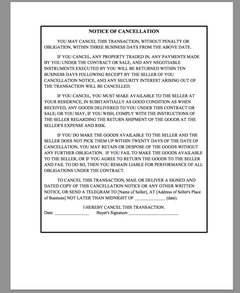
- 8 years agolast modified: 8 years ago
I simply disagree. In the very first section of the first semester of contracts law we reviewed a dozen or more cases that clearly demonstrated that a bid is an offer to do business. The one that sticks in my mind was about a mason who submitted a bid for a patio in another county site unseen and later had to honor the bid even though the job was more complicated. This stuck in my mind because of the fact that my father was a partner of a fairly large plumbing company and I had worked on dozens of bids.
I don't have access to Westlaw at this moment, but a quick search finds dozens of cases where that is true. Additionally, several construction attorney blogs have something to that effect on there. Often these involve the contractor - subcontractor relationship, but that doesn't change anything.
Here are a few:
The general rule is that subcontractors providing bids to a general contractor must perform the work contemplated by their bids for the price quoted if the general contractor is chosen to perform the work. This rule is grounded in the doctrine of promissory estoppel and is followed in most jurisdictions.
Courts have held that a party may rescind a contract for fraud, incapacity, duress, undue influence, material breach in performance of a promise, or mistake, among other grounds
------
An offer capable of forming the basis of a contract must specifically state its essential terms. Those terms include the identity of the parties, the subject matter of the contract, and the consideration (which is the price and services to be exchanged). For example, if a subcontractor’s bid sets forth those terms, then the contractor’s acceptance of that bid will typically create a binding contract between them.
----
ETA: There are certain requirements for a bid to be half a contract, but they are not that extensive. They are easily established in almost any written bid.
ETA2: Many people believe that a contract is this holy document with lots of details. All a contract is an offer and acceptance (with mutuality) to an exchange of consideration by those with capacity.
In other words, if you say I will sell you this car for $20,000 and I say yes, then we have a contract. If I say I will sell you a car for $20,000, but I don't say what car, we don't have mutuality so no contract.
If I say I will build you a house for $100,000, we don't have a contract. If I take full construction documents and say I will build you this house for $100,000 then we have mutuality and once accepted we have a contract.
This is contracts 101
- 8 years agolast modified: 8 years ago
As for Massachusetts law, please understand that a stricter requirement to make a contract enforceable on one side, doesn't automatically extend that requirement to both sides.
It isn't that different from Florida's contractor restrictions that have lots of requirements if a contractor in Florida wants to sue in court to enforce his contract, however, those same requirements do not extend to homeowners.
In other words, a homeowner could sue a contractor for breach of a contract, even when the contractor didn't meet the requirements for him to sue the homeowner. That isn't particularly unusual and it exists to address the asymmetric information in contract development, in other words they are consumer protection and not contractor protection laws.
----------
I have never seen an "estimate" in a construction contract that was "enforceable". In a Cost of the Work Plus a Fee contract a Contractor would prepare an itemized Budget which is similar to an estimate but it would not limit the Contractor's compensation unless there was also a Guaranteed Maximum Price. That's what would be enforceable.
Estimates are always somewhat enforceable under promissory estoppel. It is called detrimental reliance. If you go to an expert and he gives you an estimate, and that estimate forms the basis of your decision then his duty is established, and that estimate must be reasonable. It doesn't have to be exact, but it does have to be reasonable.
- 8 years ago
Once an estimate is incorporated into a contract it is then binding unless the line item is specifically stated to be an allowance. And if it is an allowance, then the contractor would need to justify why there is an overage over the allowance.
I think we might be dealing with semantics though. The bid I got from my GC was line items for the scope of the work with a signature line that I could theoretically have accepted which I didn’t of course because it didn’t contain any contractual terms except for the price. That was no longer an estimate except for those line items stated to be allowances and would have been binding if I had been foolish enough to have actually signed it.
In other words, if an item is stated to be the price, it’s nit an estimate.
If it’s stated to be an allowance, then it’s somewhst of an estimate but the GC is going to have the burden of proof as to why the cost wasn’t reasonably anticipated when the contract was entered into.
A bid could be accepted and generally states so and also states that it’s good for a limited period of time. But a bid isn’t an estimate
- 8 years ago
Largely the contract vs. no contract is not relevant at all. I largely brought it up in response to the idea that estimates are not worth anything.
That is a complete misconception. They certainly get a lot more leeway but they can and do create a duty on the contractor's part. Incorporation into the contract is largely moot if there is a reliance on that estimate.
It isn't really about creating a contract, it is about promissory estoppel. If you give someone an estimate and can reasonably expect that person to use your estimate in their decision making process, that estimate better be reasonable.
Having said that, it isn't like that many cases get to court. A contractor may lowball bids his entire career and never really end up in court, but again that is because no one wants to bother with it. The recovery isn't worth the effort and expense.
- 8 years agolast modified: 8 years ago
That may be the way homeowners hire plumbers and painters but my bid documents include a contract form and a bid form. I don't invite a contractor to write the contract, propose consultation fees or include unwanted estimates and allowances.
- 8 years agolast modified: 8 years ago
It seems like the OP was using the original contractor to provide cost estimates before completing a final design which might explain the request for a consultation fee. I have used a contractors for this purpose and my client paid them by the hour.
$2,500 is more than my clients have ever paid for consultation on entire house project.
Could this be another case of the "architect" being a drafter? I don't mean to malign drafters but why isn't the architect advising the OP on this matter? The contractor may be offering to provide what is not getting from a drafter. Its just a suspicion; it happens so often on the forum.
 PRO8 years ago
If my consultation needed before I submit the bid my fee is $285 dollars on smaller projects, for larger projects involving whole house construction or remodeling, it will be priced accordingly.
If the homeowner like me to make schematic drawings in 3D so they can see what the kitchen/addition will look like after completion, that will depend on the size of the project and I set my fees not to break anyone but to help them... I do lots of drawings like that for contractors and homeowners nationwide and have some clients going as far as Canada.
If this is a basic kitchen remodeling or some other smaller project, most of the time I will include the 3D schematic drawings in the consultation cost.
As material selections go, if my customer needs my help to select materials, I help them out free of charge during the course of the job. I'm not a decorator but I can help them out with selections based on my experiences... If they feel that a decorator can do more for them, they're welcome to hire one.
- 8 years agolast modified: 8 years ago
So, you’ve gone around and gotten “estimates” from a bunch of contractors without even having completed plans? And now that the plans are completed, the second round of estimates is starting? No wonder contractors want a fee up front. You’ve wasted their time without paying for it once already.
If you wanted contractor input at the planning stage, that should have been paid for, as a consultation. Now you’ve created a reputation as a tire kicker. And you’re seeing the results of that. There are going to be plenty that will just decline to work with you at all. Because even a bad contractor can be very picky about the clients that they take during this boom cycle.
Agsin, describe the addition and its difficulties. Describe the level of finish work you are expecting. Describe the area of the country. You could have easily had your front end 300-600K WAG by doing a bit of research in the beginning. Without approaching anyone locally and gaining the reputation of a dreamer.
- PRO8 years ago
Some excellent comments above on the differences between an "estimate" and a "quote"...these should become a "sticky".
That said, when one has no drawing or specifications, or just the barest set of drawings, here's the reason that many estimates aren't worth a plugged nickel (Texas term):
--Many reputable contractors, when asked for an "estimate", will respond by saying, "Happy to do so, as soon as you have detailed drawings and specifications of what you want to build...!"
--Other reputable contractors, if they will give an "estimate" based on few, if any, documents, often do so based on a set of assumptions from their past similar work. Of course, the assumptions are known only to them. When the final drawings and specifications are completed and available, the frequent contractor response may be, "Oh, I didn't know you wanted X, Y and Z in the project...!" And the final quote may differ substantially from the initial estimate. And rightly so.
--Less than reputable contractors (and they are out there) may often give a low-ball estimate as a way to attract consumers into signing a construction contract. These sorts of contractors know full well, up front, that their estimate is not based on reality, but do so knowing that they can create a construction contract which will be in their favor and allow them to make a profitable return on the actual construction costs.
Consumers often have a hard time telling the difference between the various types of contractors.
The point I'm making is that estimates, without detailed drawings and specifications, are generally not going to tell a consumer the true construction cost. That is to say, these sorts of estimates are essentially worthless.
Understanding what the cost range for a proposed new home is a very important element for most consumers.
The best way to achieve a reliable cost analysis is to find and pay a reputable and experienced general contractor to consult with the owner and architect during the design stages. For this to work well, both the architect and the general contractor have to be mutually respectful and able to work constructively with one another.
- PRO8 years ago
@Virgil Carter, I couldn't agree with you more, you cannot give a final proposal to complete the project without complete plans and details. I get a 1-page floor plan for addition with a few dimensions without roof plan, foundation details, etc and people want a written proposal. The only thing I can tell them based on this layout without seeing the existing house it can cost anywhere between 40-70k if that helps.
If they want a written "guestimate" based on the visual with me coming out to see existing conditions and get a close number to what the approximate cost will be until the final plans are ready that will involve a fee.
- 8 years agoS MacD save your breath! I’m with you 100% but trust me it is only the frustrated homeowners who are. It is no wonder there are so many issues in this industry. Pros want to never be wrong, assume the homeowner is the problem, and move on.
- PRO8 years ago
There's some really good commentary and advice on this thread...for those looking for it.
Unfortunately, on many of these "estimates vs. quotes" threads, it seems like it always evolves to "consumer wants" vs. "professional experience"...
Take your pick.
- 8 years agolast modified: 8 years ago
Whether the OP has all of the things required to get a solid estimate is largely not a material fact. There are two services that many here, including myself, assume the contractor is providing - (1) Design services (the extent of which varies widely as I thought it minimal, and others seem to think the OP has a sketch on the back of a napkin), and (2) General Contractor estimate/bid/contract. The question becomes the value of those two services and whether or not $2,500 is a reasonable amount for a homeowner to pay for a combination of those services.
The answer to that depends a bit, if the design services are durable and portable (live beyond the bid and can be taken to other contractors), then it is absolutely a value added service and some amount of compensation is absolutely reasonable and should be expected. Depending on the scope of the project $2,500 may be completely reasonable.
However, if it is only to be used by this contractor it is very obviously a product differentiation strategy and the fee should be eliminated or severely limited, as that adds no value to the project. The idea that a contractor has additional costs because the homeowner isn't prepared is a completely legitimate one, however, collecting a fee to help them prepare and then sending them on their way unprepared is not.
---------
People who rely on the benefits of the former to sell the latter are simply adding a fee to reduce competition. If they are in a market or a situation where they can do that, that is their prerogative. However, don't pee down my back and tell me it is raining. If you are charging $2,500 to construct a bid that only you can use, don't pretend that you are doing consumers a favor.
- 8 years agolast modified: 8 years ago
Unfortunately, on many of these "estimates vs. quotes" threads, it seems like it always evolves to "consumer wants" vs. "professional experience"...
As far as picking sides. I advise finding the side that is rationalizing a behavior and then move to the other side. There are many people here who are advocating for a fee based on the amount of work that goes into it. However, if you can't advocate for the value of a service then advocating for the fee is ridiculous. I don't think any consumer on the planet gives a crap why you think it is fair to charge for any service, we want to know why we get value from paying that fee.
There may well be great reasons and great value added but unless the pro's can move from telling consumers why they think it is fair that they charge and start telling consumers why they think it is valuable, the pro's will continue to endure this discussion.
----
ETA: I should note that the pros are adding substance to the discussion, even if we disagree on some points. For example, both JDS and G.N. builders have certainly addressed the reasonableness of fees. Which is certainly part of the question.
- 8 years agolast modified: 8 years ago
Why would the contractor be expected to provide design services if an architect was involved? The OP appears to be looking for free estimating services. Did I miss something? I often do.
This discussion should be about good project management not contract law. As pointed out earlier these matters rarely go to court. You can be legally correct and still run a project into the ground with sloppy management.
First step: define the parties, second step: define the work. Neither has occurred yet.
- 8 years agolast modified: 8 years ago
Why would the contractor be expected to provide design services if an architect was involved?
Because the OP said. "Our Contactor wants $2,500 to put a bid together, help me sellect finishes, and establish a timeline." [emphasis added].
I assume that means that it is not a fully specified contract. I am not talking building design so much as interior design.
----------
This discussion should be about good project management not contract law.
This discussion should be about the reasonableness of paying $2,500 for a contractor to help put a bid together, help select finishes, and establish a timeline.
On this board, especially of late, these discussions have largely devolved into the contractor side which tend towards any fee charged by a contractor is reasonable, and the consumer side which tends towards no fee is reasonable.
Personally, I believe a small fee is fine, but larger fees need some value added.
----------Many areas are charging these fees because they can, and for really no other reason. Contractors for many projects are in high enough demand that they can add the fee just for putting a detailed bid from fully specced plans.
Mica Moore thanked bry911 - PRO8 years ago
Well...like so many consumer postings about design and construction, the original posting is unclear.
"...Our Contactor wants $2,500 to put a bid together, help me sellect finishes, and establish a timeline..."
Bidding, finish selections and project timeline are three completely different things. What they all have in common is obvious: they will take the time and expertise of the general contractor.
What should a general contractor charge for his time? After all he is running a business, must pay his employees and his overhead, pay himself, and make sufficient profit to stay in business and continually upgrade and improve his business in a competitive marketplace.
The contractor obviously does not have a signed contract with the OP, since the OP is asking for a "competitive bid"...
We don't know the scope involved with selecting finishes and creating a project timeline, but these are outside the normal scope of a competitive bid for a residential construction contract.
If the OP had an architect, or other design profession, there certainly would have been a fee for selecting finishes and creating a project schedule wouldn't there?
I'm not suggesting that $2,500 is the proper fee, since I have no idea of the scope of service.
The point is that the OP's request goes beyond simply asking for a competitive bid for a construction project.
- PRO8 years ago
S MacD, you need to take a couple of aspirin and lie down...
At this rate you're gonna hurt yourself.
Mica Moore
Original Author8 years agolast modified: 8 years ago@sophiewheeler - I was completely upfront when I met with the contractors initially. I told them that I was fact finding and planning. They all instructed me to come back to them with plans for a more accurate bid. None of the contractors I found draw plans. Only one could put me in touch with an available architect. None of them asked for a fee. I have no construction or planning knowledge. Most homeowners don’t. Architects can’t give accurate numbers. Please explain how we are supposed to figure out what we can afford and what is plausible without talking to a professional? I was asking about the fee because I haven’t seen it before in my area, not because I don’t value his time. Also, I have chosen most of my finishes already. I have even downloaded software to draw plans to show what I want. I’m not sure what you expect from clients?
- 8 years agolast modified: 8 years ago
"I have a separate architect that I am paying for plans and permitting."
It was that statement that is responsible for the confusion.
No one needs to tell you $2,500 is too much for a cost estimate based on no drawings or selecting fixtures.
- PRO8 years ago
Mica, I'm sorry this thread is so confusing.
This was your original post, "...Is it normal for a contractor to ask for a consultation fee before they will give you a bid? Our Contactor wants $2,500 to put a bid together, help me sellect finishes, and establish a timeline. We are doing a kitchen remodel and a small addition..."
In this scenario, you asked the contractor for three very different things, two of which contractors don't normally do, especially at the bidding stage:
A competitive construction bid to build your project (this is a normal step in the bidding and building business; a builder might only ask for a fee for this if s/he's very busy, or other human chemistry reasons, which normally is credited back to the owner if the builder gets the construction contract);
Assistance in selecting finishes (this is not a normal step for a builder--owners and their designers commonly pick all finishes and give the builder drawings and specifications which include this);
Establishing a project schedule (again, this is not a normal step for a builder during a competitive bid process)
And you wanted all of this as part of a competitive process, where the builder was bidding against an unknown number of other builders.
So, if my understanding is correct, the builder responded by asking to be compensated for the time necessary to respond to your requests.
Given, what we know, the request is not particularly unusual, IMO.
If you now have all the finish materials specified, and the project schedule determined, then you may wish to ask for a bid without all of the other requests, to see how the builder may respond.
Keep in mind, however, that you may have used up your credibility with this particular builder.
Good luck on you project.
- 8 years agolast modified: 8 years ago
What should a general contractor charge for his time? After all he is running a business, must pay his employees and his overhead, pay himself, and make sufficient profit to stay in business and continually upgrade and improve his business in a competitive marketplace.
ANSWER: ZERO!
Welcome to middle school economics. We never pay for someone else's time. EVER! We sometimes donate money to charities, but that is as close as we come to paying someone for their sake. We pay for added value, and nothing more.
People find their own time valuable and are willing to trade that time to you for some compensation. However, you are only willing to pay because you value the thing they are providing. You can't sell your time to people unless you provide them with some value.
-----------
E.g. Suppose you order a medium pizza from a local pizza delivery joint and they show up at your door without a pizza. The driver notes that they cooked the pizza for you, they cut it, boxed it, and paid a delivery driver to bring it to your door. The driver accidentally went to your neighbor's house and he felt guilty about waking them up, so he gave them the pizza. Now the owner would like to collect from you for his time. After all he is running a business, must pay his employees and his overhead, pay himself, and make sufficient profit to stay in business and continually upgrade and improve his business in a competitive marketplace.
Does that sound reasonable? NOPE.
------------
So in response to your question. What is the contractor doing for me? How much time he spends doing it, is simply not the consumer's concern, only how it increases our value. A business may charge an entry fee simply to be considered, and consumers may pay that for the consideration as they value working with that business. However, that is not compensation for time spent.
Mica Moore
Original Author8 years agoThe builder and I are in excellent terms. He wants to to the finish selection and timeline, it is part of his normal process. I didn’t ask for it. I am just trying to make responsible financial decisions in an area that I don’t know much about.
- 8 years ago
I expect anyone undertaking a project to research costs before hiring anyone. The information is available, if you just try. If you discover that a master suite addition runs 150K+ in your area, and your budget is 75K, I dont expect you to consider making appointments with Pros shopping for a miracle. You’re actually shopping for a hack to lie to you.
I expect someone who engages a design professional to actually pay the money for a complete design. That goes beyond a “layout”. That includes specification documents and project oversight all rolled into space planning. If you want to pay an architect for a layout, then you still need to pay an ID or KD for the rest of the package that you need to be able to solicit bids.
I expect that when I or any other professional asks someone about the anticipated Scope of Work, their budget, and their expectations, that they will give me an answer. If I have to ask twice, you just got disqualified from anyone I know, and that’s a lot of pros, doing your project.
I’ve already asked you twice to provide additional information, and you have never responded. You flunked that test handily. That moves you into tire kicker category. And that category pays a fee to move forward. Which is what is being asked of you here. It’s the get real or get gone fee. Others would just decline your business outright.
I expect a customer to be as respectful of a professional’s time as they should be of yours. If a contractor does not wish to be involved in your project, they should say that they are over booked and not taking on new projects at the moment. I would not expect them to say that they don’t want to be involved in a train wreck, as some disinterested party from the outside can observe and be more truthful about.
[https://www.houzz.com/discussions/10-tests-for-you-and-your-contractors-first-meeting-dsvw-vd~5332686?n=90[(https://www.houzz.com/discussions/10-tests-for-you-and-your-contractors-first-meeting-dsvw-vd~5332686?n=90)
- 8 years agolast modified: 8 years ago
Seriously, is your architect so incompetent that you need to seek advice from architects online? Can't he/she help with the selection of fixtures, etc. I don't mean to be critical of you, I am truly puzzled.
Mica Moore
Original Author8 years agolast modified: 8 years agoThanks for some very helpful comments. It seems like things have gotten pretty convoluted and off topic. So I am going to step away.
I have told my contractor that I am happy to compensate him, as it seems like he is providing extra services( finish selection, and timeline). I asked him to clarify if we get ownership of the list of prices and vendors of the sourced finishes. I also asked him to clarify if the fee will go towards the final cost of the project.
Thanks again for some valuable suggestions and insight.
- PRO8 years ago
bry911, welcome back from China.
As for my posting, your response completely missed the point. Deja vu!
"... People find their own time valuable and are willing to trade that time to you for some compensation. However, you are only willing to pay because you value the thing they are providing. You can't sell your time to people unless you provide them with some value..."
The OP asked the builder for three work products.
The builder responded with an answer, which included a $2,500 fee.
It's that simple.
- 8 years agolast modified: 8 years ago
Mica, did you mean "the plans" ? I don't mean any disrespect but you should determine if he/she is an architect, in other words, registered. That can usually be determined from a state registration look-up online.
- 8 years agolast modified: 8 years ago
"your response completely missed the point."
I'm shocked that anyone would think there's a point to any of this.
- PRO8 years ago
"...I'm shocked that anyone would think there's a point to any of this..."
Yep, I agree. It's up there with the Wandering Threads of All Time.
- 8 years agolast modified: 8 years ago
The point is when a clear post, with well defined terms, and an accurate description of the issue is laid out, including pictures and diagrams, there is much less left open to subjective interpretation. Subjective interpretation fosters a whole lot of Wandering. In all aspects of life. Then the lawyers get involved....
At no point is the actual Scope laid out. That’s a stop work red tag flag right there.
At no point are the “plans” given an accurate description to know if they are full architectural plans with specifications or just a floor plan with some structural nods. It sound like Not, but the OP seems to think they have purchased a different service than it appears that they have purchased.
At no point does the OP explain that they understand the difference between an architect and a draftsman, or a 2 semester CAD class computer geek with bad software. And there is s post in there wondering why builders wouldn’t create plans and give her s bid on those. Which is a total misunderstanding of the design process.
At no point is it even explained how someone termed as “my contractor” received that title without some form of remuneration or contract taking place.
But it IS apparent that “my contractor” is getting cheated on with third parties. So, this must be like the live in girlfriend still dating others. Shoulda put a ring on it. Probably too late to commit now.
 PRO4 years ago
It is very normal for a contractor or a designer to charge a consultation or a bid fee (to prevent tire-kickers) but this also helps protect our professional expertise from being taken and handed off to the next guy to do "less" work.
Unfortunately, I have fallen victim of that and the client took my ideas and gave them to the next person who ended up charging them more in the long run. I have learned that charging for a consultation helps people understand that you are serious and won't waste your time (tire-kicking) if they are actually ready to start their project.
Do you get paid to do your job? A consultation for a designer or a contractor is time on the job, and they too should be paid to do their jobs. Therefore, charging a fee should be standard, some people don't and that's okay!
I do believe that as a client, you are entitled to question the consultation fee if it seems too high and see what they need to do for the price that they are requesting.
Lastly, my consultation fee is credited back to the client if they choose to work with me. If not, no hard feelings but then I keep the fee and let the client know that I was reimbursed for my time and expertise shared during our meeting.
Hope this helps answer your question, I do see that there are many responses to this post already!
Have a wonderful day!- PRO4 years ago
@Alyessa Andreeva Interior Design I couldn't agree with you more, been charging for consultation and estimates for the last 12-15 years with great success.



geoffrey_b