


Recent Activity
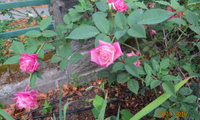

White Maman Cochet, climbing.
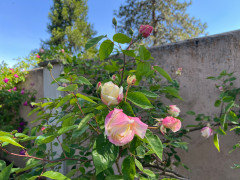

Climbing White Maman Cochet was a favorite at the beach. It was so agreeable to being grown to enormous sizes in fifteen gallon nursery cans and trained on 8' poles so they could be installed to provide immediate color and coverage when needed. I put them on "high culture", keeping the flower buds pinched off to push growth, in premium soil and fed "weekly, weakly". It didn't take long to push huge climbers loaded with buds which literally sold themselves to landscrapers and homeowners alike.
catspa - I love the look of that rose! Mine is still on the back porch. It did grow taller, and is putting out new leaves. I took off the top upside-down fish tank, so it is not in a "greenhouse" anymore, and the bottom fish tank is still protecting it from the cat, who just sniffed it and left it alone. We have a very large pot I was thinking of planting it in outside, but after reading your advice again I think I will pot it into a one gallon pot and put it outside. It has cooled off a lot here, so I am no longer worried about it frying. Thanks for the help -
Jackie

John, thanks and here is a link for 'Mainz' on HMF: https://helpmefind.com/rose/l.php?l=2.39467, and here is a link for 'Kardinal Piffl': https://helpmefind.com/rose/pl.php?n=30202. HMF's search function has at times been a little capricious and persnickety for me lately, too -- especially annoying are the spelling changes it INSISTS on that are wrong (like changing "etoile" to "toile" repeatedly when I'm trying to get to 'Etoile de Feu' -- sometimes I have to go to Google and put in the correct variety name and specify "HMF" there in order to get a link that works -- oy!).
There, at least, is one thing AI is good at, Jackie -- vacuuming up every little mention in print that it can find. Interesting though that it only mentions HMF as a source in association with the Kordes rose 'Goldenes Mainz' in your second link and not at all in your first link -- maybe it couldn't get to the Leenders 'Mainz' on HMF either :-).
Here are the pics:
PEACE
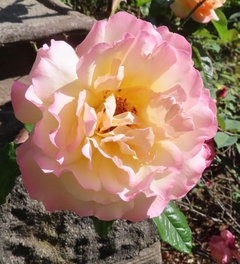
LE VESUVE
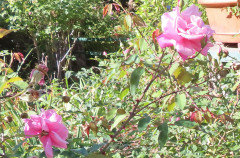
Yes, that's a female carpenter bee and they do love salvias best of all. The males, seen far less frequently (by me, at least) are large, orange and fuzzy. They aren't aggressive and never cause issues here.
Thank you! It is interesting that we have lived in this house for 35 years, and never seen any carpenter bee damage. I have never seen an orange fuzzy male - I will keep an eye out.
I know about those tunnels, because at my parent's -in- law's house, there was an entire section of flat siding way up near the roof that had rows of those tunnels, which the termite inspector caught when we were selling the house. When I was a child I even saw large black bees like these going in and out of holes in sandstone on Carmel beach - that must have been a more "natural" place for their tunnels, before they learned about houses.
Maybe they don't like shingles? Our entire house is shingled for 3 stories, and I can't recall any flat places. We just had it painted, and the painters were all over it (from 3 story high scaffolding) for several weeks, and I am sure I would have heard about it from my DH if there was that sort of damage anywhere. Maybe the bees just came for the salvia.
Jackie
I have a friend who has a Summer home in Kennybunkport, right on the beach. All along her street, there are rugosa hedges - all perfectly happy in the freezing winters and salt air. She said it was difficult to NOT have one or two plants form a hedge - all you had to do was not let them spread in anything other than the straight line you wanted.
Jackie
Good heavens, Kim - so THAT is what Rountuit is supposed to look like! It's stunning in a proper environment, but like all roses the location matters. In my relatively alkaline soils (or whatever else is wrong for them in my yard) most Rugosa hybrids do TERRIBLY. Hansa was a scrawny blackspotted mess of a once bloomer, Therese Bugnet was a huge tree of a (nearly) never bloomer, and all the Pavement roses take one look at me and die a rapid screaming death. And no, I don't spray them. I know that Rugosas don't like chemical sprays, but neither do I. Way too lazy.
I had Rountuit about 10 years ago in prime real estate and it survived multiple years but was definitely classed among the "almost never bloomers". If it did bloom it was the occasional scrawny scruffy pink tuft that was downright ugly. Along with Harlow Carr (another dreadfully ugly bloom in my climate), and Fimbriata (a truly never bloomer over 8 years), it was one of the only 3 roses I have deliberately shovel pruned in my garden. I offered to send Burling my entire plant of Rountuit, but she declined and presumably she has one of her own if she wanted it. I'm so glad it does well for someone, but it's not coming back here. Ever.
There are a few stellar hybrid Rugosas that actually do well for me, and two of them are Moore creations. Moore's Striped Rugosa is still a small spindly grower in its second year but it has survived pretty well and blooms periodically. I'm expecting good things next year and the blooms are a sprightly clean stripe with a good shape. The incomparable Linda Campbell is a beast and a reliable steady bloomer, and for me the undisputed queen of rugosa types. The other great rugosa for me has been Mrs. Anthony Waterer, which put out wave after wave of deeply colored blooms in a non-ideal spot for a couple of years. For some reason it didn't survive last winter even though rated to zone 4. She's getting replaced this year. I'm also giving Rugelda a try because - c'mon, a yellow rugosa? Gotta try it at least once.
Good to know what the hybrid rugosas aren't the thugs the species rugosas are, getting back to Ian's original question. I'm interested in planting more OGRs including at least one species rose, but I am cautious about letting suckers run rampant. I know Ian is interested in suckering roses, but I've dug out too many in previous incarnations of my garden to appreciate them anymore. I'll plant the lovely gallicas and other suckering roses in tubs around the garden with highly protected bottoms, but they don't get unrestricted access to my yard anymore.
Cynthia
I'm sorry, Cynthia, but I'm not surprised. Why should something bred and selected in Zone 9b Central Valley, CA with its colder than a personnel manager's heart winters and bellows of Hades summers LIKE Zone5 Nebraska? Yes, there are "rugosa" genes in there but they're not the majority, just enough of them that they react negatively to rust spores where they are present. There were quite a few I trialed in similar conditions to those in which they were born which did with me what the did with you. I'm also not really surprised at Hansa failing you, either. I TRIED growing Hansa, Rose à Parfum de l'Hay, Roseraie de l'Haÿ all because the colors and scents were supposedly SO delicious and the others like Sir Thomas Lipton, the bedeviled CF Meyer and far too many to even bother trying to dig out the proper spelling of only to discover they HATED my climate, HATED my soil and HATED my water. They HATED being where I had for them to grow and they demonstrated it by RUSTING every chance they got. And, as you pointed out, you CAN'T spray the blamed things or they turn yellow, go totally bald then repeat the entire process all over again. Same thing with Eglanterias, by the way. Love them, they HATE hot/arid. Rugosa rubra and alba simply went totally white, absolutely chlorotic and RUSTED. I fell hook, line and sinker for GS Thomas' love letters to all of them and they HATED where I was. It took a long time but I've limited myself to ONLY those which are happy with what I can/will provide for them. If they can't/won't be happy with me, they can bloody well go elsewhere. I've had MUCH "mulch" which began life as well known named roses...