
Coming Soon - House Extension Faversham
An extension that contrasts the home’s current appearance, but that
references it’s past and form of construction.
The existing house is a post-war precast concrete Airey house, designed by Sir Edwin Airey and built by the Ministry of Works emergency factory made housing programme. The house is built with a slender prefabricated concrete structure and was originally clad in precast concrete panels which expressed externally the concrete form of construction. This external concrete cladding was replaced with brick in the 1980’s as a result of the Housing Defects Act. This provided a more suburban appearance and substantially changed the external concrete appearance of the house.
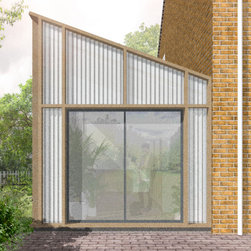
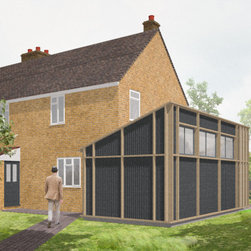
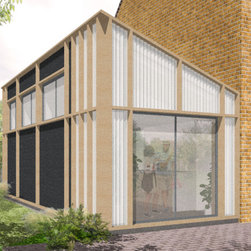
The single storey extension deliberately contrasts the form and current appearance of the existing house. The roof form is angled away from the house to provide large high level windows in order to maximised natural light internally. The extension continues the original idea of external structural expression but in timber. The new timber frame is expressed and celebrated, with black profiled steel cladding and polycarbonate glazing infilling between the timber frame to provide a cost effective but striking design.
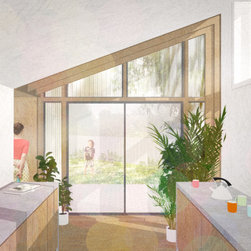
The brief was to create a space that blurred the relationship between house and garden, to create the qualities of a contemporary conservatory. To the rear the extension deconstructs towards the garden revealing a translucent inner layer creating a heightened visual and acoustic connection with the outside.
Internally the extension provides a new kitchen, downstairs WC and shower room, back door and utility area. The existing ground floor is reconfigured to provide a new dining area.
references it’s past and form of construction.
The existing house is a post-war precast concrete Airey house, designed by Sir Edwin Airey and built by the Ministry of Works emergency factory made housing programme. The house is built with a slender prefabricated concrete structure and was originally clad in precast concrete panels which expressed externally the concrete form of construction. This external concrete cladding was replaced with brick in the 1980’s as a result of the Housing Defects Act. This provided a more suburban appearance and substantially changed the external concrete appearance of the house.
The single storey extension deliberately contrasts the form and current appearance of the existing house. The roof form is angled away from the house to provide large high level windows in order to maximised natural light internally. The extension continues the original idea of external structural expression but in timber. The new timber frame is expressed and celebrated, with black profiled steel cladding and polycarbonate glazing infilling between the timber frame to provide a cost effective but striking design.
The brief was to create a space that blurred the relationship between house and garden, to create the qualities of a contemporary conservatory. To the rear the extension deconstructs towards the garden revealing a translucent inner layer creating a heightened visual and acoustic connection with the outside.
Internally the extension provides a new kitchen, downstairs WC and shower room, back door and utility area. The existing ground floor is reconfigured to provide a new dining area.
Project Year: 2020
Project Cost: £50,001 - £75,000