
Bespoke End Grain Wood Floor and Headboard
When a client asks for something really special, you know you have to pull out all the stops. We knew exactly what to suggest for this brief, a bespoke end grain block wooden floor. This spectacular floor isn’t something you see very often nowadays, but before the introduction of concrete, it was commonly used in factories, as it’s incredibly strong and hardwearing.
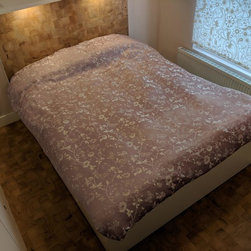
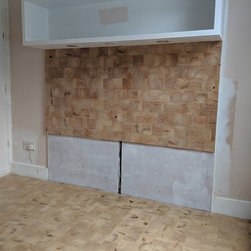
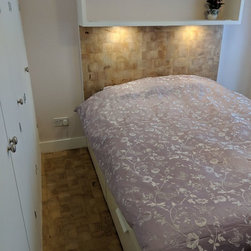
We fitted the flooring in two rooms and made a feature headboard for the main bedroom. End grain blocks aren’t very easy to source. As so much of the grain is exposed, the wood absorbs water like a sponge, making it susceptible to twisting and distorting. It can be made by special order but this takes time and is expensive. With our experience and wood crafting skills, we were able to make the cobbles ourselves from natural grade solid pine. It was cut on site and then fitted immediately, so there was no danger of the wood moving.
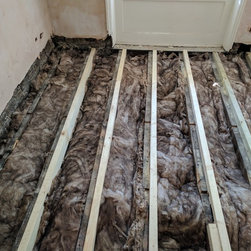
With end grain flooring, it’s essential for the subfloor to be level and strong. The original Victorian suspended subfloor wasn’t in the best condition and when we removed the old floorboards we found lots of rubbish left by previous trades. This had to be cleared up, so the air could circulate freely. The rotten joists were replaced and we repaired those that were damaged. We then insulated between the joists with mineral wool.
A superior quality hardwood ply was then fitted (we don’t use cheaper ply made from mixed species as it’s not as strong and is prone to delamination). The floor was measured so we could work out the best alignment, to ensure symmetry between the rooms and the walls. Once the preparation work was complete, we were ready to cut the 90 mm by 90 mm blocks from the solid pine beam. Using a circular saw fitted with a dust extractor, we cut 25 mm slices at a 90 degree angle. Any inferior blocks were kept back for the flooring hidden by the furniture.
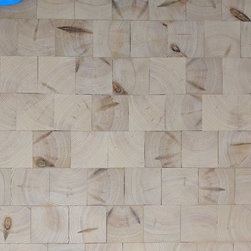
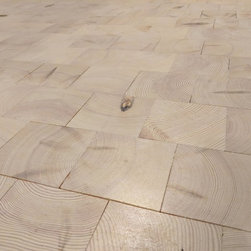
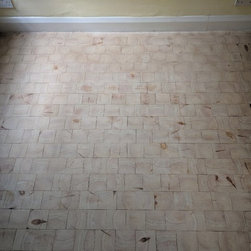
End grain flooring has a rustic, imperfect look which is complemented by the gaps which have to be left between the blocks. This is part of its charm but will also give the wood room to move when it expands and contracts. The use of a strong, flexible adhesive also allows for movement and prevents the corners from lifting and twisting.
The wood was then ready to sand. As end grain wood is stronger than traditional boards, we cut the blocks slightly thicker than required to allow for the extra sanding. To finish, the wood was sealed with one coat of Osmo Raw Oil to create a pure natural look without any yellow tones, followed by a coat of clear Osmo Satin. Our final job was to fit the skirting board.
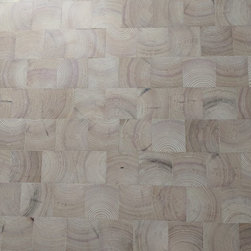
End grain flooring is a historical product, not only for its use in the past but also because the exposed grain tells the story of the forest. The visible growth rings provide clues to the weather conditions at that time.
This is a beautiful product which is extremely strong, so the floor will last for years.
We fitted the flooring in two rooms and made a feature headboard for the main bedroom. End grain blocks aren’t very easy to source. As so much of the grain is exposed, the wood absorbs water like a sponge, making it susceptible to twisting and distorting. It can be made by special order but this takes time and is expensive. With our experience and wood crafting skills, we were able to make the cobbles ourselves from natural grade solid pine. It was cut on site and then fitted immediately, so there was no danger of the wood moving.
With end grain flooring, it’s essential for the subfloor to be level and strong. The original Victorian suspended subfloor wasn’t in the best condition and when we removed the old floorboards we found lots of rubbish left by previous trades. This had to be cleared up, so the air could circulate freely. The rotten joists were replaced and we repaired those that were damaged. We then insulated between the joists with mineral wool.
A superior quality hardwood ply was then fitted (we don’t use cheaper ply made from mixed species as it’s not as strong and is prone to delamination). The floor was measured so we could work out the best alignment, to ensure symmetry between the rooms and the walls. Once the preparation work was complete, we were ready to cut the 90 mm by 90 mm blocks from the solid pine beam. Using a circular saw fitted with a dust extractor, we cut 25 mm slices at a 90 degree angle. Any inferior blocks were kept back for the flooring hidden by the furniture.
End grain flooring has a rustic, imperfect look which is complemented by the gaps which have to be left between the blocks. This is part of its charm but will also give the wood room to move when it expands and contracts. The use of a strong, flexible adhesive also allows for movement and prevents the corners from lifting and twisting.
The wood was then ready to sand. As end grain wood is stronger than traditional boards, we cut the blocks slightly thicker than required to allow for the extra sanding. To finish, the wood was sealed with one coat of Osmo Raw Oil to create a pure natural look without any yellow tones, followed by a coat of clear Osmo Satin. Our final job was to fit the skirting board.
End grain flooring is a historical product, not only for its use in the past but also because the exposed grain tells the story of the forest. The visible growth rings provide clues to the weather conditions at that time.
This is a beautiful product which is extremely strong, so the floor will last for years.
Project Year: 2018
Country: United Kingdom
Postcode: SE6 4RU