
Modern Bespoke Staircase Clad In Engineered Oak
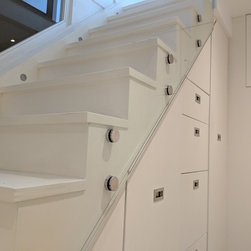
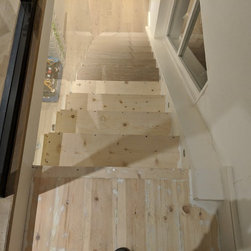
We love a challenge. This bespoke staircase project was just that! We were called to a house in Putney, which had just undergone a complete refurbishment. However, the owners were very disappointed with the modern wooden staircase, leading to the basement. Although they loved the modern glass balustrade, the wooden treads were marked with dents and the paintwork had already begun to chip. The issue was that it had been built using soft pine. As soon as we saw the stunning structure, we knew we would be able to provide the solution and achieve the high-end finish the homeowners desired.
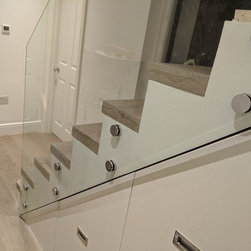
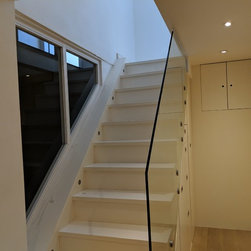
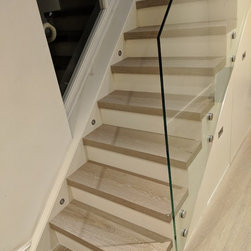
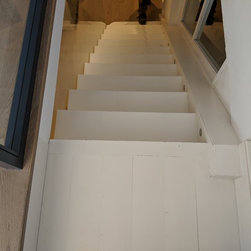
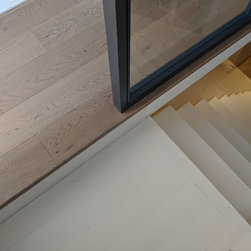
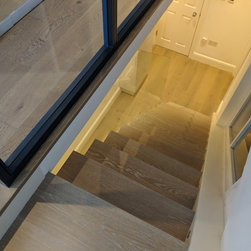
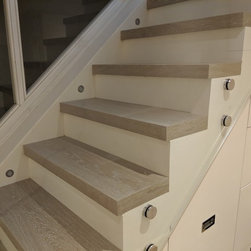
The first floor and basement featured a lovely light grey engineered wooden floor. Although the staircase was an architectural feature, the white painted stairs didn’t link the two areas together. Instead it blocked the flow of the house. The solution was to fit wooden treads to match the wooden flooring and create a continuous and balanced look. As there was no natural light in the area, it was agreed that the white risers should remain. As these wouldn’t be walked on, the paint and softwood wouldn’t be an issue.
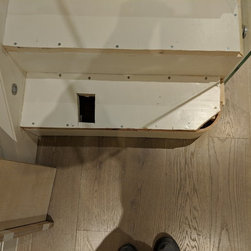
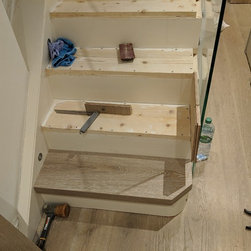
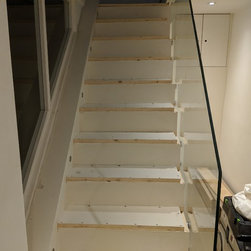
Our first job was to investigate how the stairs had been built. We knocked a hole into the bottom step, which revealed that the treads were integrated into the structure. This meant that they had to stay in place. Removing the large glass partition wasn’t an option either, so we had to work out how to fix in the new treads without weakening the structure.
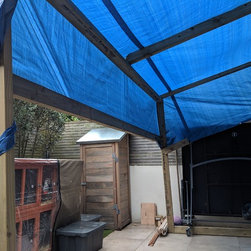
Each new step had to be carefully cut individually on site. Cutting inside wasn’t possible as the lack of adequate ventilation meant that it would be far too dusty. Instead we constructed a tent like structure in the garden. The canopy kept our tools (and the team) dry and out of the rain and meant our work ran without any delays.
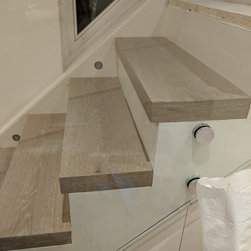
To fix the treads into place, we had to cut a section of wood out of every step next to the glass balustrade. This allowed us to slot and fix the new step into place. Every step was cut with a mitred edge at the front and sides. We then fitted a piece of wood with matching mitred edges to the face of the steps. These were glued into place with an invisible seam. The boards we used were 20 mm thick, but by adding the extra wood, they looked much thicker at around 50 mm.
The homeowners were delighted with the end result. The new revamped staircase really looks the part and is in keeping with the high-finish achieved in the rest of the stunning house. We were delighted with the transformation too. It was very rewarding to fulfil such a tricky brief and deliver such a crafted, bespoke service.
The first floor and basement featured a lovely light grey engineered wooden floor. Although the staircase was an architectural feature, the white painted stairs didn’t link the two areas together. Instead it blocked the flow of the house. The solution was to fit wooden treads to match the wooden flooring and create a continuous and balanced look. As there was no natural light in the area, it was agreed that the white risers should remain. As these wouldn’t be walked on, the paint and softwood wouldn’t be an issue.
Our first job was to investigate how the stairs had been built. We knocked a hole into the bottom step, which revealed that the treads were integrated into the structure. This meant that they had to stay in place. Removing the large glass partition wasn’t an option either, so we had to work out how to fix in the new treads without weakening the structure.
Each new step had to be carefully cut individually on site. Cutting inside wasn’t possible as the lack of adequate ventilation meant that it would be far too dusty. Instead we constructed a tent like structure in the garden. The canopy kept our tools (and the team) dry and out of the rain and meant our work ran without any delays.
To fix the treads into place, we had to cut a section of wood out of every step next to the glass balustrade. This allowed us to slot and fix the new step into place. Every step was cut with a mitred edge at the front and sides. We then fitted a piece of wood with matching mitred edges to the face of the steps. These were glued into place with an invisible seam. The boards we used were 20 mm thick, but by adding the extra wood, they looked much thicker at around 50 mm.
The homeowners were delighted with the end result. The new revamped staircase really looks the part and is in keeping with the high-finish achieved in the rest of the stunning house. We were delighted with the transformation too. It was very rewarding to fulfil such a tricky brief and deliver such a crafted, bespoke service.
Project Year: 2019